For many drivers, AdBlue is just the blue pump at the servo you’ve never thought about, but if you drive a diesel vehicle in Australia, there is a good chance you will have to deal with it at some point. Maybe when a dashboard warning light comes on, or when a mechanic mentions it during a service.
But if you’re running a fleet operation or even a single ute, you should know that many modern diesel vehicles can’t run properly without AdBlue. Getting it wrong can cause serious downtime for your business.
This guide is for diesel drivers, tradies, and fleet owners. It explains exactly what AdBlue is, which vehicles need it, what to do if it runs out, and where you can buy it across Australia.
What Is AdBlue and What Does It Do?
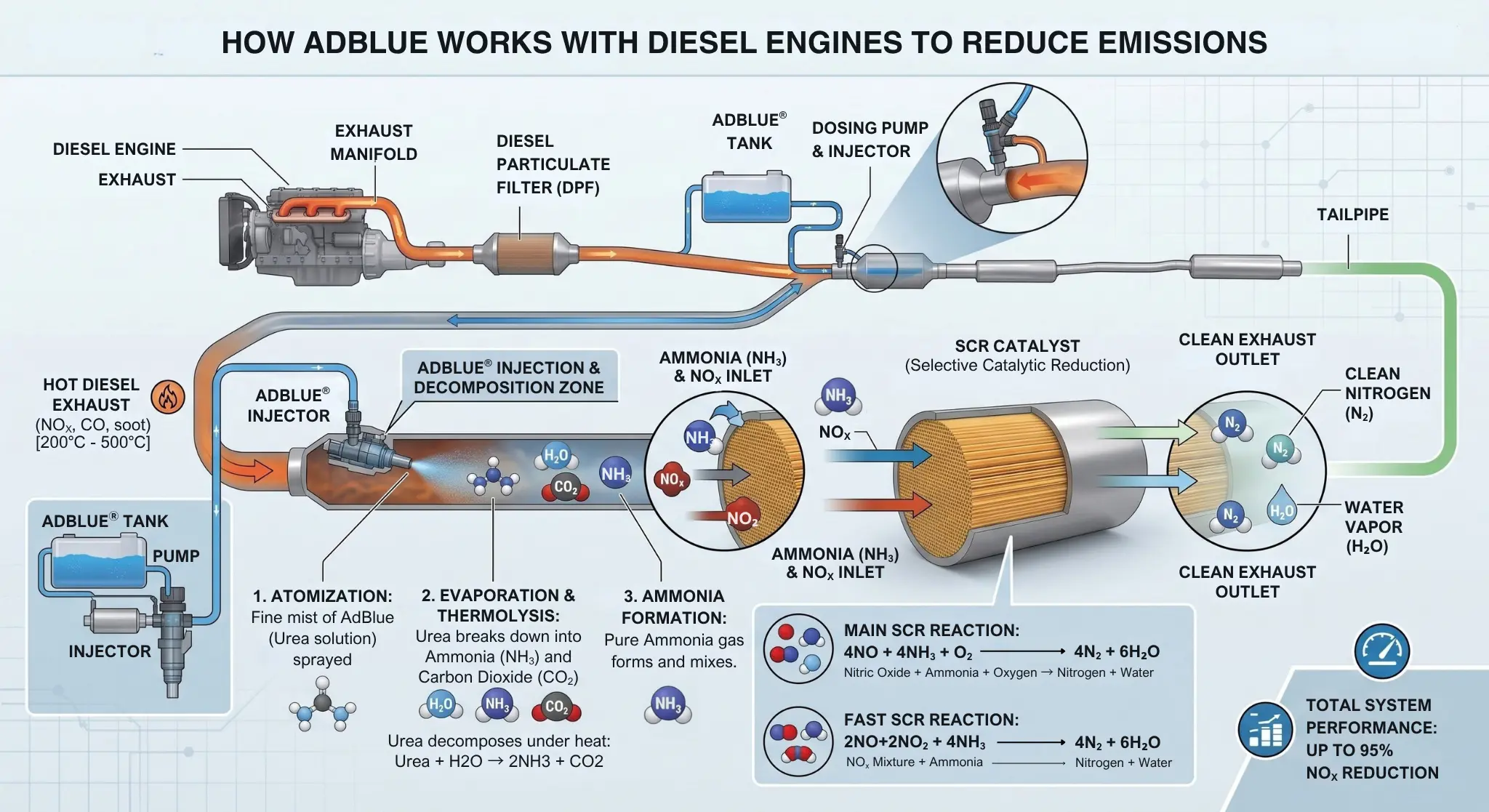
AdBlue is a clear, non-toxic liquid, made from a very precise mix of high-purity urea (32.5%) and demineralised water (67.5%). It isn’t a fuel additive. Vehicles have a separate tank for it, separate from the diesel.
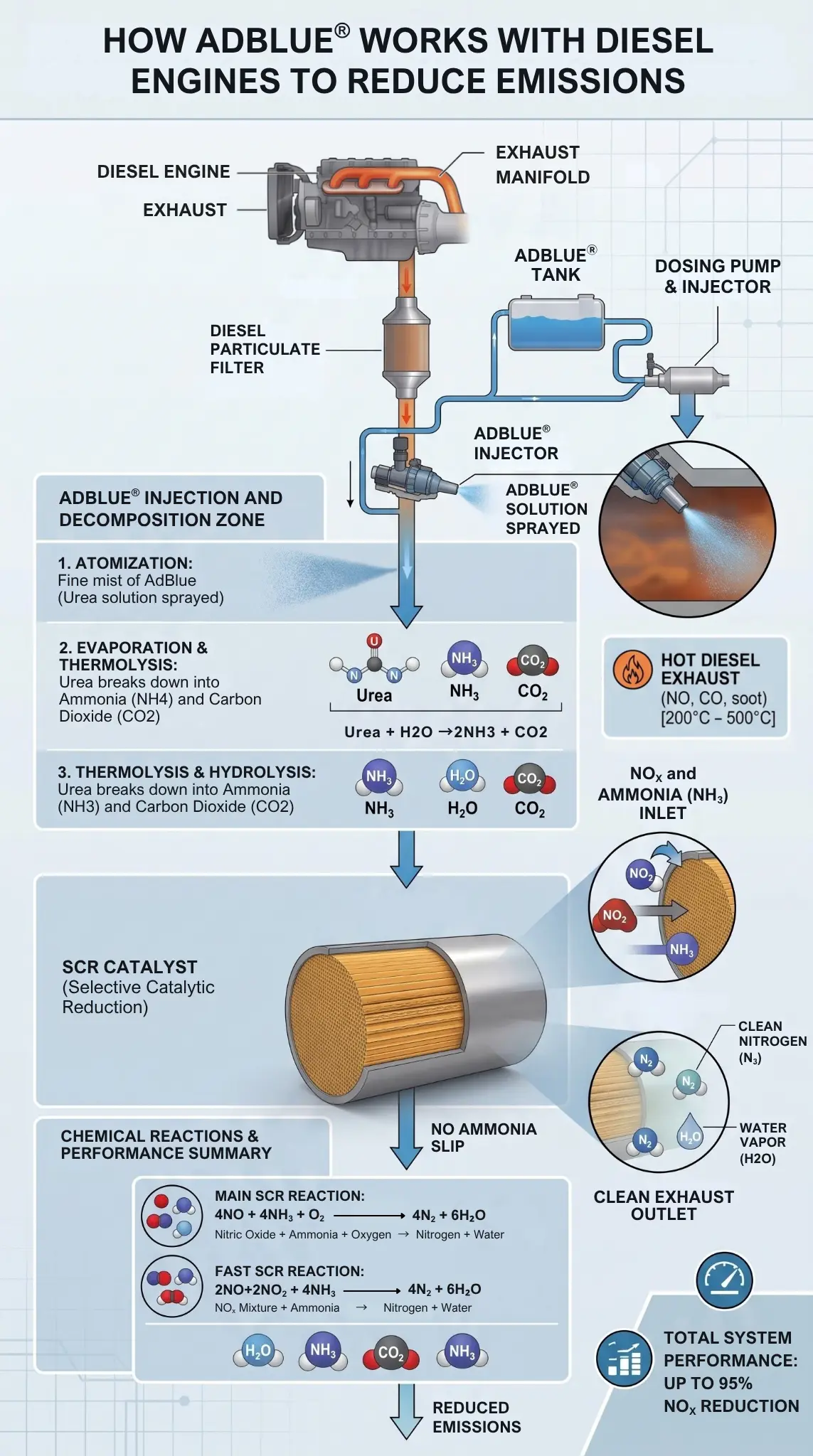
Instead, it works with a system built into your exhaust called Selective Catalytic Reduction (SCR). Modern diesel engines produce nitrogen oxides (NOx), a pollutant that adds to smog and can irritate your lungs.
Vehicles with SCR deal with this by spraying a small, measured amount of AdBlue into the exhaust. It reacts with the nitrogen oxides and turns them into nitrogen and water vapour. This can cut emissions by up to 95%.
Why It’s Mandatory for SCR-Equipped Vehicles
If your vehicle is built with an SCR system, AdBlue isn’t optional. It’s not a rule added afterwards; it’s wired into the engine management system itself.
The engine is designed to depend on AdBlue to legally meet its emissions standard, so if the tank runs dry, the vehicle cuts its power, in some vehicles, almost immediately.
Can I Safely Drive My Vehicle Without AdBlue in the Tank?
No, it is not safe to drive without AdBlue. In fact, once AdBlue runs out, most SCR-equipped vehicles drop into a low-power mode. Many won’t restart at all until the tank is refilled.
You can’t get around this with water or another DIY substitute; the engine reads the actual AdBlue level, not just whether something is in the tank.
Is All AdBlue the Same?
While you might see it labeled as AdBlue, Diesel Exhaust Fluid (DEF), or AUS 32, it’s all the same fundamental product.
What matters is the quality. Any fluid you buy must meet the ISO 22241 standard. Cheap or non-compliant fluid can damage the SCR system, reduce emissions performance, and lead to expensive repairs.
Which Vehicles Need AdBlue?
Only vehicles fitted with an SCR system use AdBlue. As a general rule, heavy trucks and buses have relied on SCR for over a decade. For light vehicles, the requirement varies heavily by specific models and variants. You can’t just say “most diesels from 2010” need it.
Here is what we know about current popular models:
|
The quickest way to check your own vehicle: look for a blue filler cap near the diesel filler, check your dashboard for an AdBlue indicator, or check the owner’s manual.
What’s Changing: Euro 6d
Australia is introducing stricter Euro 6d emissions rules for light vehicles, which means AdBlue is going to become much more common.
Any brand-new vehicle models introduced from 1 December 2025 will have to comply, and all new vehicles sold will need to comply by 1 July 2028.
If your vehicle is already registered, it won’t be affected.
How Much AdBlue Will You Use?
Heavy and light vehicles use very different amounts. A truck or bus typically uses 4 to 6 litres of AdBlue for every 100 litres of diesel. A car or ute uses much less: around 1 litre per 1,000 km if lightly loaded, or 2 to 4 litres per 1,000 km if it’s doing heavier work.
Here is a rough idea of what you can expect to use:
Average monthly AdBlue consumption estimates for single diesel utes, light commercial fleets, and heavy transport trucks.
| Setup | Rate | Rough monthly use |
| Single diesel ute, ~2,000 km/month | 2–4 L per 1,000 km | 4–8 L |
| Small fleet, 5 light commercial vehicles at ~3,000 km each | 2–4 L per 1,000 km | 30–60 L |
| Heavy truck burning 10,000 L of diesel a month | 4–6% of diesel | 400–600 L |
These numbers are merely a guide, though. Depending on the load, terrain and driving style, some owners are able to get close to 15,000 km out of a full tank, and most light vehicles only need a top-up every 5,000 to 10,000 km.
For fleet operations, it is recommended that AdBlue be checked at every pre-start and topped up at every refuel, rather than waiting for the warning light.
What Happens If You Run Out of AdBlue?
Your vehicle won’t just suddenly die on the highway. You will get plenty of warning lights early on telling you exactly how many kilometres you have left before the tank is actually empty.
Once the tank is empty, most engines then cut power, and the maximum speed gets capped until you top up. In many models, if the engine is switched off with an empty tank, it won’t start again.
For individual drivers, that’s annoying. But for a business, the downtime is more expensive than the fuel itself. Experienced drivers know to top up at the first warning and keep a spare container in the vehicle just in case.
Put AdBlue in Your Diesel Tank? What to Do Next
Unless you are careful while refueling, it is easy to mistake cap colours.
| ⚠️If you accidentally pump AdBlue into your diesel fuel tank, do not even turn the key or start the engine. Call a mobile wrong-fuel service or a mechanic. If you’ve already driven it, stop as soon as it’s safe. |
This is because as soon as AdBlue gets sucked into your engine’s hot, pressurised fuel lines, the urea inside it will crystallise. These hard crystals will shred your fuel pump, clog your injectors, and completely destroy the fuel system.
You will need to get a mechanic to drain and flush the tank, replace the filters, and check the fuel system.
The exact same damage happens if you accidentally put AdBlue into a petrol car. It doesn’t have an AdBlue tank, but it’s still possible to pour AdBlue into the petrol filler by mistake.
A few habits stop this from happening. Pay attention to cap colours before you pour; AdBlue caps are usually smaller and blue. For fleets, add it to driver training, or fit magnetic nozzles that only fit the right filler.
Where to Get AdBlue
At the Pump
Filling up at the pump is the easiest way to go. You only pay for what you need; no tub to buy, store or carry around.
It’s worth noting that AdBlue isn’t always available at pumps everywhere. Even massive industry players like Ampol only have it at some of their sites, so it’s better to plan beforehand.
Burk has AdBlue at the pump at:
Western Australia: Landsdale, Malaga, Bassendean, Alkimos, Oakford
Victoria: Bendigo
Packaged AdBlue (10L and 20L Containers)
You can buy tubs of AdBlue at auto stores and most servos. It’s a great idea to keep a 10L tub in the tray of the ute or back of the truck as a backup.
However, it does cost more per litre than at the pump or in bulk.
Bulk AdBlue Delivery
If you run a fleet, you’re using a lot of AdBlue regularly. In this case, ordering bulk delivery and storing it in an on-site tank is the smartest way to manage your supply.
How Much Does AdBlue Cost?
The price per litre mostly comes down to how you buy it.
- Buying containers is the most expensive; you’re paying for the packaging and the retail markup.
- Buying at the pump cuts that out, since you only pay for what you fill in the tank.
- Buying it in bulk is usually the cheapest option of all.
Keep in mind that, like fuel, AdBlue prices are also tied to global urea supplies, which is exactly what caused the massive Australian AdBlue shortage in 2021. It’s a good reason for businesses to build a relationship with a stable, reliable supplier rather than constantly looking for the lowest price on the day.
How to Store and Handle AdBlue
Contaminated AdBlue can be more harmful for your engine than you can imagine. And most cases of contamination are rooted in storage. You must store it in high-density polyethylene or stainless steel containers, and label them clearly.
Heat matters a lot too. In fact, its shelf life completely depends on the temperature it is stored at:
- At or below 25°C: Lasts roughly 18 months.
- At 30°C: Lasts roughly 12 months.
- At 35°C: Lasts roughly 6 months.
In a Western Australia summer, this is a massive deal. A tin shed or the back of a parked van sitting in the afternoon sun can easily exceed 30°C, which will rapidly degrade your fluid.
Store it in the shade where you can. Check the manufacture date when it’s delivered, not the delivery date.
It can also corrode aluminium, copper and zinc, so keep it away from containers or fittings made from these metals. If you spill some, just rinse it with water before it crystallises.
Common AdBlue Mistakes
- Ignoring the warning light: Get your tank refilled at the nearest pump as soon as your supply runs low.
- Using the wrong fluid: Only ever use ISO 22241-compliant fluid; the system isn’t fooled by substitutes.
- Contaminated supply: Dirty containers and unsealed storage cause more SCR damage than almost anything else.
- Not tracking how much you use: If you don’t monitor your fleet’s consumption, you’re more likely to run out at the worst possible time.
- Storing above 30°C: Don’t let your backup supply bake in the sun; it’s the easiest mistake to avoid.
Bulk AdBlue for Fleets, Farms and Mine Sites
If you are running a fleet of SCR-equipped trucks, tractors, or mine site machinery, buying in bulk makes a lot of sense. Once you’re using a couple of hundred litres a month, the savings in price and time add up fast.
While a small 5-van fleet can probably get away with a simple routine of topping up at the local pump, larger fleets need onsite tanks, a proper delivery schedule, and AdBlue added to the pre-start checklist.
Keep in mind though, that proper arrangements for the storage of this bulk AdBlue are critical. Make sure the on-site tank is sized to hold what your fleet will actually use. Schedule deliveries so stock doesn’t sit around for months; it should turn over well within its shelf life. The storage should be shaded, and the vehicles should be fitted with magnetic nozzles to prevent mistakes.
If you already get diesel in bulk, ask whether AdBlue can come on the same delivery. One supplier, one run, less to manage.
Conclusion
Managing AdBlue isn’t complicated; the problem comes down to timing and management.
Top up when the warning light tells you to, buy the right ISO-certified fluid, and keep your storage out of the heat.
With Euro 6d bringing AdBlue to more vehicles every year, it’s a bigger part of running a diesel fleet than it used to be.
Burk Fuel supplies mining, agriculture, transport and logistics, and marine operators across WA and Victoria. We can set up a schedule to deliver your AdBlue alongside your bulk diesel drops, so that you don’t have to worry about running out.
Call 08 6205 9900 or request a quote through our contact page to find out if your site is in our delivery area.
Frequently asked questions
No. Your car will eventually go into a reduced power mode, and once turned off, it will lock you out and refuse to start.
Yes, the pump stops once your tank is full, the same way a normal fuel pump does. It’s still worth watching it until it finishes.
The fluid will heat up, crystallise, and ruin the fuel pump, lines, and injectors. Do not start the car; call a mechanic immediately to drain the tank.
No. While many have packaged containers available, pumps are not universally available at all stations.
It freezes around −11°C and is fine once it thaws, so cold weather won’t ruin it. The bigger risk is heat: It doesn’t spoil exactly, but it won’t last as long in hot storage.