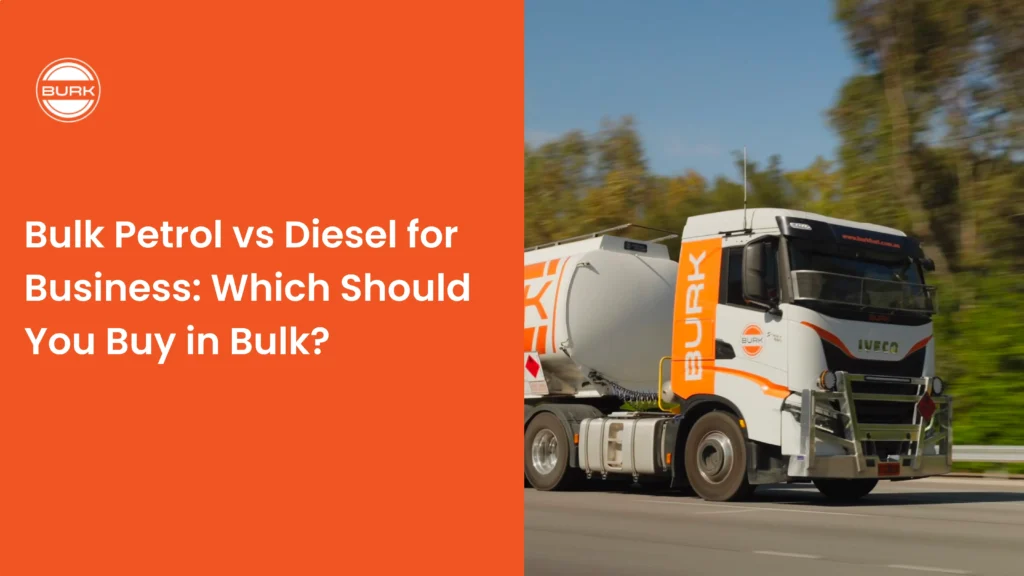
Australian businesses, farms and contractors can buy both petrol and diesel in bulk. Commercial distributors deliver bulk fuel directly into on-site tanks.
Diesel remains the standard for heavy machinery and long-haul transport, and petrol suits light commercial ute fleets, generators, and small plant equipment.
The biggest catch is storage. Petrol is a highly volatile flammable liquid, and diesel is only combustible, so the legal and storage requirements differ between the two.
What counts as bulk?
In dangerous goods rules, “bulk” has a defined meaning. Western Australia’s regulator, for example, treats a container holding more than 500 litres as bulk.
In practice, what counts as a bulk delivery depends on three things:
- The supplier’s minimum drop size
- The capacity of your storage tank
- Your site location.
What runs on petrol vs diesel
Petrol typically fuels utes and light commercial fleets, generators, quad bikes and side-by-sides, boats and outboards, and small plants such as pumps, compactors and mowers.
Diesel typically fuels trucks, tractors, harvesters, loaders, excavators and larger machinery.
A lot of operations in Australia run both, which usually means two tanks and two sets of storage rules. Audit your actual petrol use before committing to permanent infrastructure.
Which petrol grade do you need?
Buy the grade your equipment manufacturer specifies, and no higher. The right Research Octane Number (RON) protects engine efficiency, prevents misfuelling, and protects manufacturer warranties.
- Regular unleaded (ULP 91): the baseline grade. Most petrol cars since 1986 sold in Australia are designed for it.
- E10: regular unleaded blended with up to 10% ethanol, usually marketed as 94 RON (read the label). It carries roughly 3% less energy per litre, and not every engine is approved to run on it, so check the manual.
- Premium unleaded (PULP 95 and 98): premium fuel must be at least 95 RON. Searches often say “ULP 95”, but 95 and 98 are both premium grades. You only need them where the manufacturer sets 95 or 98 as the minimum.
All petrol sold in Australia, including E10, must meet the national standards under the Fuel Quality Standards Act 2000.
Which grades are available for bulk fuel delivery varies by supplier, so check the fuels each one lists, including Burk’s fuels.
How bulk petrol pricing works
Commercial bulk fuel pricing in Australia is based on wholesale benchmarks rather than retail pump prices:
| Delivered Bulk Fuel Price = Terminal Gate Price (TGP) + Freight Logistics Fee + Supplier Margin |
Terminal Gate Price (TGP)
The wholesale spot price for bulk fuel collected at a fuel terminal. Under the Oilcode, wholesale suppliers publish their TGPs daily. The price moves with international benchmark prices, international freight rates and the AUD/USD exchange rate.
The Australian Institute of Petroleum (AIP) publishes TGP averages inclusive of both Federal Fuel Excise and GST.
But when providing a commercial B2B quote, suppliers will often strip the GST out to show your base business cost, and then re-apply the 10% tax to the final invoice, so keep that in mind.
Federal Fuel Excise
The Australian Government applies a flat excise rate per litre on liquid fuels. This tax is already added in the TGP, so there is no direct exemption.
Eligible businesses claim relief afterwards through the Australian Taxation Office’s (ATO) Fuel Tax Credits (FTC) scheme. Fuel used in light vehicles of 4.5 tonnes gross vehicle mass or less on public roads, including utes, is not eligible. Fuel used in machinery, generators and other equipment, or in light vehicles off public roads, can be.
Freight Logistics Cost
Freight is the cost of transport from the terminal to your site tank. It is typically 1.5 to 4 cents a litre higher for country delivery than city delivery, per the AIP, so your location matters.
Supplier Volume Margins
The supplier adds its own margin. Larger drops typically cost less per litre to freight because the cost is spread over more fuel.
All these components of wholesale pricing determine how cost effective bulk petrol delivery could be for your operations compared to retail stations.
Storage & Compliance for Diesel vs Petrol
The most critical operational difference between bulk petrol and diesel is dangerous goods classification and storage compliance. Both are bulk petroleum products governed by Australian Standard AS 1940.
| Feature | Commercial Diesel | Petrol (ULP 91, PULP 95 and 98) |
| Dangerous Goods Class | Class C1 Combustible Liquid | Class 3 Flammable Liquid |
| Flash Point | > 61°C (Low volatility at ambient temp) | < −40°C (Highly volatile, gives off flammable vapours) |
| Vapour Ignition Risk | Low at ambient temperature | High: vapour can ignite at ambient temperature and collects in low areas |
Petrol’s very low flash point means it gives off flammable vapour even in cold conditions, so regulators set lower storage thresholds for it.
Compliance Requirements in Western Australia
In Western Australia, bulk flammable liquid storage is regulated under the Dangerous Goods Safety (Storage and Handling of Non-explosives) Regulations 2007, administered by the Department of Local Government, Industry Regulation and Safety (LGIRS) through WorkSafe.
- Licensing: needed above the manifest quantity, which is 10,000 litres for petrol.
- Diesel alone: If stored alone, diesel has a 100,000-litre threshold, but that drops to 10,000 litres if it sits in the same bunded compound as petrol.
- Rural exemption: properties of 5 hectares or more, outside the metro region and townsites, can be exempt from licensing for agricultural use. They must still follow the storage regulations.
Compliance Requirements in Victoria
In Victoria, the storage and handling of bulk petrol is regulated under the Dangerous Goods Act 1985 and the Dangerous Goods (Storage and Handling) Regulations 2022, enforced by WorkSafe Victoria.
The thresholds below set the minimum compliance steps. Tank design, bunding and hazardous area rules come from AS 1940 and your installer, so confirm them with the regulator.
Caption: Petrol storage thresholds in Victoria
| Petrol stored | What you need |
| Above 250 litres | Warning placards, at least 1.8 metres from any residence, and a powder and foam extinguisher |
| Above 2,500 litres | Placards and manifests, at least 4.2 metres from any residence, notification to the authorities, an emergency management plan, more extinguishers and a fire hydrant |
These differences in state regulations mean a tank that needs no licence in WA can trigger manifest rules in Victoria. This is general information, not legal advice, so confirm current requirements with the regulator before installing a tank.
For day-to-day compliance, see our guides to bulk fuel safety standards and maintaining a bulk fuel storage tank.
Shelf life and fuel quality
Petrol and diesel age very differently, which directly impacts inventory management strategies. Petrol is a blend of components that evaporate at different rates, so it loses volatility as it ages. Diesel ages more slowly.
BP Australia’s guidance puts storage life at:
- Sealed container, under shelter: about 12 months
- Container once opened: about six months at 20°C, or three months at 30°C
- Equipment tanks: about one month
- Diesel, sealed and under cover: about 12 months, sometimes longer
Those figures are for containers, not bulk tanks. A site tank’s real shelf life depends on how fast you turn it over.
As a rule of thumb, businesses should only order bulk petrol in volumes they can comfortably use within 60 to 90 days, especially through summer.
Delivery Logistics and Minimum Volumes
Minimum order volumes
Every supplier sets its own minimum drop. It typically depends on the tanker’s compartment sizes, the distance travelled and the size of your tank, and it can differ by grade.
Delivery areas
Coverage depends on a supplier’s depots and tanker routes. Regional and remote sites may face higher freight charges or longer lead times, so confirm your site is in the delivery area.
Transport rules
For road transport of petrol, each state applies the national ADG code through its own regulations. In Victoria, moving more than 1,000 litres of petrol brings in the full Dangerous Goods (Transport by Road or Rail) Regulations 2018, including placards, paperwork and fire extinguishers on the vehicle. Choose a supplier that can show its tankers and drivers are compliant with state regulations.
Before you order
When buying petrol in bulk, first understand how bulk fuel delivery works, then ask each supplier:
- What is the minimum delivery volume, and does it differ by grade?
- Which petrol grades do you deliver in bulk, and to which areas?
- Is the price fixed or TGP-linked, and is it ex or inc GST?
- Do you advise on tank compliance and dangerous goods paperwork?
Conclusion
If your business operates heavy machinery on diesel, a ute fleet on petrol, or both, having a compliant on-site storage strategy protects your operational bottom line.
Burk Fuel supplies both petrol and diesel in bulk. To discuss bulk fuel delivery for your site, contact Burk Fuel’s team.
Frequently asked questions
Yes. Businesses can buy petrol in bulk from commercial distributors. Burk Fuel supplies ilk petrol in the same grades it sells at its service stations, so contact the team to discuss minimum volumes and delivery for your site.
Each supplier sets its own minimum, which depends on delivery location, tanker compartment sizes and your tank size.
Yes, within limits. In WA, qualifying rural properties can be exempt from licensing for agricultural use but must still follow storage regulations. In Victoria, thresholds of 250 and 2,500 litres apply. Use an AS 1940-compliant tank and confirm rules with your local regulator.
It depends on your volume, location and timing. Bulk petrol is priced from the TGP plus freight and margin rather than retail pump prices.
Petrol loses volatility as it ages. BP Australia puts the life of opened petrol at about six months at 20°C, or three months at 30°C. Stale petrol may cause hard starting and rough running, so rotate stock and size your tank to your usage.