If your business uses a lot of diesel, someone has probably already suggested bulk delivery. That’s often a sensible move to control costs, but the tank you get to store the diesel in matters just as much, and it’s easy to get wrong.
So how big a diesel tank do you need? It depends on three things: how much diesel your business uses in its busiest months, your supplier’s delivery volumes requirements, and a safety stock buffer in case of delays.
Too small, and you’re ordering all the time, sometimes in a panic. Too big, and you’ve paid for storage you don’t need while the unused diesel degrades for months. This guide walks through the exact math, step by step, with worked examples for a workshop, a farm, a fleet depot and a construction site.
How to size an on-site diesel tank: the formula
To size a tank correctly, you must work out your required delivery volume, and then add a safety stock. At the same time, you must be aware of the fact that a tank can’t legally be filled to the brim.
| The Sizing Formula: Usable capacity needed = delivery volume + safety stock Rated tank size = usable capacity ÷ safe fill percentage |
- Delivery volume: how much diesel you get in one delivery. It is either going to be based on your usage between deliveries or your supplier’s minimum order, whichever is larger.
- Safety stock: the buffer fuel left in the tank when the next delivery arrives, so that a late delivery or a busy week doesn’t stop your operations.
- Safe fill percentage: how much of a tank’s rated capacity can safely be filled. Under Australian Standard AS 1940:2017, this is capped at 95%.
Note that your tank’s size dictates your delivery schedule, but it is not the same as a reorder level. The reorder level answers a different question: when to place an order. The formula above works out how big the tank needs to be to take it.
Step 1: Measure your peak diesel use
Don’t just size a tank based on your annual average. You must size it for your busiest period. Pull your fuel records or invoices and look for your highest-consumption month. If you operate in agriculture, this will be your seasonal harvest peak.
If you do not have historical fuel records, you can estimate your baseline using standard equipment burn rates:
Hours (or kilometres) per week × fuel burn × number of machines.
Use the manufacturer’s fuel consumption figures where you can.
| Machine or vehicle | Number | Hours (or km) per week at peak | Fuel burn (L per hour or per 100 km) | Litres per week |
| Your machine or vehicle | ||||
| Total |
Step 2: Set your delivery volume
Once you know your peak diesel usage, decide how often you want fuel delivered. This establishes your baseline delivery volume.
Next, check that result against your supplier’s minimum order quantity (MOQ). Bulk tankers carry fuel in compartments, and suppliers set minimums to guarantee their margins on each run. If your usage over the delivery cycle is below that threshold, the supplier’s minimum becomes your delivery volume, and your tank must be able to take it.
For example, if your baseline weekly usage is 5000 litres, but your supplier’s MOQ is 10000 litres, you will need to go for a fortnightly (2-week) delivery cycle and get a tank that can accept a 10,000-litre drop.
Delivery frequency changes the answer. Here is the same site using 500 L a day, assuming each volume is above the supplier minimum:
| Delivery cycle | Delivery volume | What it means |
| Every week | 3,500 L | Smaller tank, more deliveries |
| Every 2 weeks | 7,000 L | A middle option |
| Every 4 weeks | 14,000 L | Bigger tank, fewer deliveries |
Step 3: Add safety stock
You must plan for a safety buffer in your delivery volume, so that you are not left with zero stock on delivery day. This buffer will account for late deliveries, severe weather events, sudden demand spikes, or supply chain disruptions.
Set one agreed buffer figure for your site, typically 20% of your delivery volume, or a minimum of three to five days of peak operational supply.
Remote sites and critical operations need more cover than a workshop with a servo around the corner, and anyone worried about shortages during peak demand should add more still. Fleets can build safety stock into their wider fuel planning.
Step 4: Convert usable capacity to rated tank size
Add your delivery volume and safety stock to get the usable capacity you need. Then allow for the fact that you can’t use every litre a tank is rated for.
A 10,000-litre tank cannot legally hold 10,000 litres of usable fuel. To prevent dangerous overflows and allow for fuel expansion in Australian heat, tanks have a safe fill level.
AS 1940:2017 limits this to 95% of tank capacity, so divide your usable capacity by 0.95 (or by your tank’s own figure, if it’s lower).
For example, 10,000 L of usable capacity needs a tank rated at about 10,500 L (10,000 ÷ 0.95). Manufacturers publish their own safe-fill figure for each tank, and it can be lower than 95%. One 10,000 L tank, for example, lists a safe fill of 9,000 L, so use the figure on your tank’s data sheet.
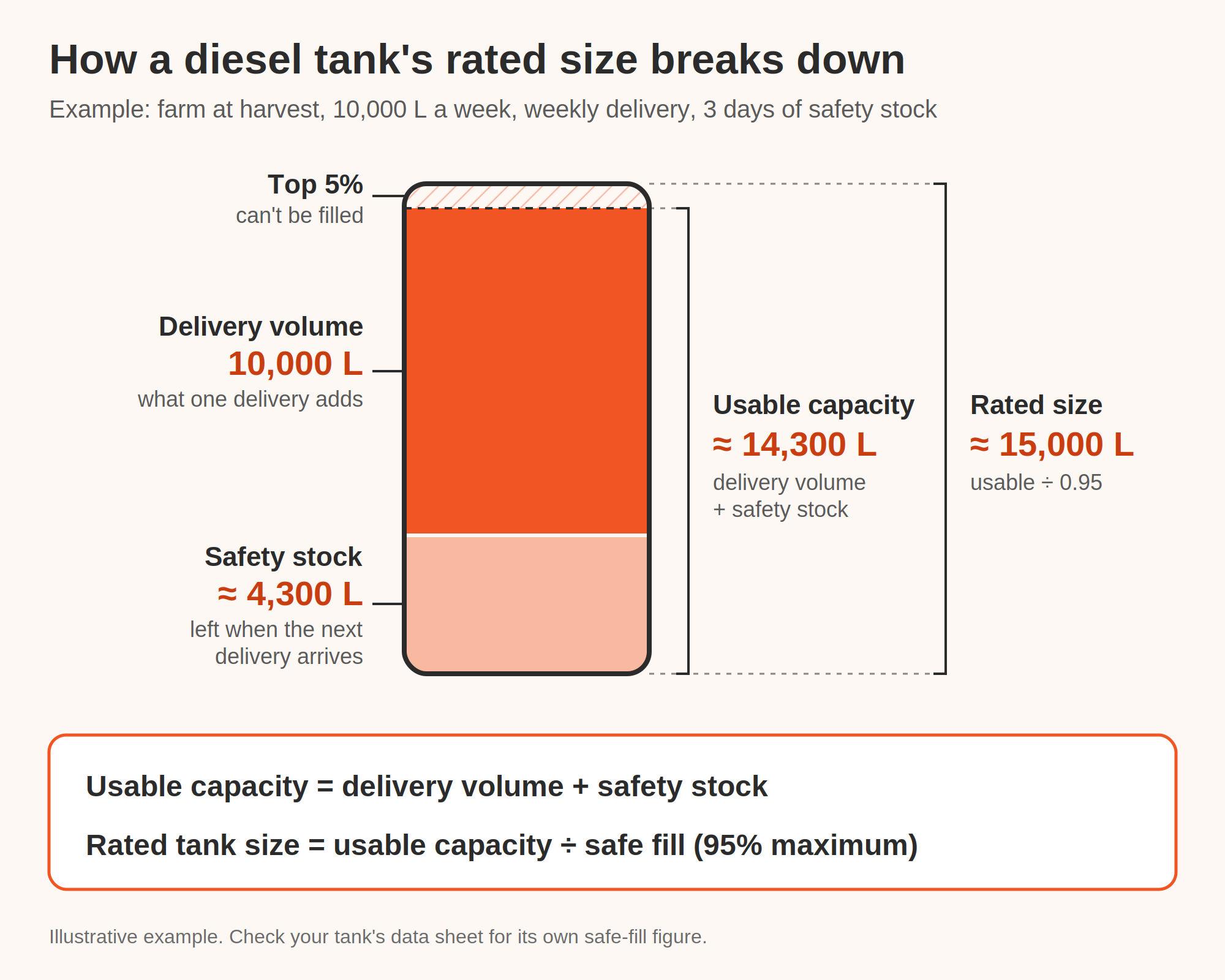
Why a 15,000 L tank is sized for about 14,300 L of diesel: one delivery, a safety cushion, and 5% left empty.
Step 5: Check storage compliance before you buy
Diesel is a C1 combustible liquid. Before ordering your tank, verify that your site can legally and safely accommodate it. In WA and Victoria diesel counts as a dangerous good for storage (though not for road transport), so quantity thresholds apply.
AS 1940:2017 sets the technical rules for how it is stored and handled, but state regulators enforce quantity thresholds. Bigger tanks face stricter requirements; a size that looks sensible on a spreadsheet might push your site into a heavier compliance and licensing category.
These are the quantities where the rules change for diesel:
| WA (DMIRS) | Victoria (WorkSafe) | |
| Diesel stored on its own | 10,000 L | 100,000 L |
| Diesel stored with other fire-risk dangerous goods | 1,000 L | 10,000 L |
| Beyond the manifest quantity (diesel on its own) | A site licence is needed above 100,000 L | A manifest, notification to WorkSafe and a written emergency plan |
AS 1940:2017 also requires a high-level alarm on above-ground diesel tanks over 25,000 L, and above-ground diesel storage generally needs secondary containment, which is why many sites choose self-bunded tanks.
Always check current state regulations before purchasing, as laws change (e.g., Victoria’s dangerous goods laws are slated for updates in April 2028).
Step 6: Pick a standard size and tank type
Because tanks are manufactured in standard sizes, you must round your calculated rated size up to the nearest available model. Never round down.
| Size band | Typical use | Things to check |
| Up to about 5,000 L | Small workshops, contractors, light vehicle fleets | Is the supplier minimum larger than the tank? |
| About 5,000 to 20,000 L | Farms, small fleets and depots, mid-sized sites | Delivery minimums and storage thresholds |
| Above about 20,000 L | Large depots, major farms, industrial sites | Stricter storage requirements; you may need more than one tank |
There are three common commercial tank types:
- Self-bunded: built-in secondary containment and a compact footprint. The most popular choice for commercial sites.
- Skid-mounted or transportable: can be moved easily, which makes them ideal for civil projects and temporary construction sites.
- Fixed above-ground with a separate bund: requires a separate, custom-built concrete bund. Involves more site design work but suits massive, permanent industrial installations.
If you only need storage for a season or a project, hiring a tank might be a better option than buying one.
Diesel tank sizing examples for four typical sites
These examples are illustrative, so replace the numbers with your own data. They assume the AS 1940 maximum safe fill of 95% (the maximum) and 3 days of safety stock.
A small contractor or workshop
Six utes and light trucks use 600 L a week at peak (approx. 86 L a day). With a 4-week (monthly) delivery cycle, usage over the cycle is 2,400 L.
Say however, that the supplier minimum is 3,000 L, so the delivery volume becomes 3,000 L. Safety stock is 3 days × 86 L, about 260 L.
Usable capacity is about 3,260 L, and the rated size is about 3,400 L (3,260 ÷ 0.95). Choose the next standard size up (e.g., a 4,000 L standard tank).
Here the supplier minimum, not your usage, dictated the size.
A farm at harvest
Headers, tractors and trucks use about 10,000 L a week at peak, with weekly delivery. The delivery volume is 10,000 L.
Safety stock is 10,000 ÷ 7 × 3, about 4,300 L. Usable capacity is about 14,300 L, and the rated size is about 15,000 L (14,300 ÷ 0.95). Choose the next standard size up (15,000 to 20,000L).
A fleet depot
Twelve prime movers use about 20,000 L a week. With weekly delivery, the delivery volume is 20,000 L and safety stock is about 8,600 L.
Usable capacity is about 28,600 L, and the rated size is about 30,100 L. You need a 30,000 L+ tank setup. However, because this breaches the 25,000 L threshold, AS 1940 requires high-level alarms, and strict state licensing may apply.
As an alternative, you could take delivery twice a week. Delivery volume halves to 10,000 L. Usable capacity falls to 18,600 L, and rated size drops to 19,500 L. A standard 20,000 L tank now fits perfectly, avoiding heavier compliance rules.
A construction or project site
Six machines use 3,000 L a week for a ten-week project. With a weekly delivery cycle (assuming 3,000 L is above the supplier’s minimum), the delivery volume is 3,000 L.
Safety stock is about 1,300 L, so usable capacity is about 4,300 L and the rated size is about 4,500 L. A 5,000 L tank fits.
Because the project only lasts about ten weeks, hiring a tank may make more financial and operational sense than buying one.
5 common diesel tank sizing mistakes
1. Sizing on the basis of the average use instead of the peak: Your tank will run dry during your busiest, most profitable weeks of the year.
2. Ignoring usable capacity: Tanks cannot be filled to the brim. If you assume a 10,000 L tank holds 10,000 L of realistically usable fuel, your delivery scheduling will fail.
3. Ignoring the delivery minimum: If your tank is too small to accept a supplier’s minimum delivery volume, you will face hefty short-load delivery fees.
4. Not accounting for future growth: Buying a tank that fits today’s fleet perfectly means you’ll need to buy a second one as soon as you add two new trucks.
5. Checking the compliance rules after buying: Buying a massive single-wall tank only to discover your local council requires a concrete bund will blow out your project budget.
Need help determining the exact specifications for your site?
Contact the Burk Fuel team today. We can audit your site usage and provide a competitive quote on bulk fuel deliveries and compliant self-bunded tank solutions.
Frequently asked questions
There isn’t one typical size. Small sites often use a few thousand litres, while farms and depots can run to tens of thousands. Calculate from your own usage and delivery cycle rather than a standard figure.
That comes down to your delivery cycle and your reorder level. The usual approach is to order when the tank reaches a set level, so a delivery arrives before your safety stock is depleted.
Not always. While larger bulk deliveries can lower your cost-per-litre, a larger tank costs more upfront, can trigger stricter state storage regulations, and leaves fuel sitting longer. Always size it directly to your usage and optimal delivery cycle.
It depends on your timeline. Short-term civil or seasonal projects are usually better suited to hiring a tank, whereas permanent fleet depots and long-term agricultural sites benefit from the ROI of buying outright.